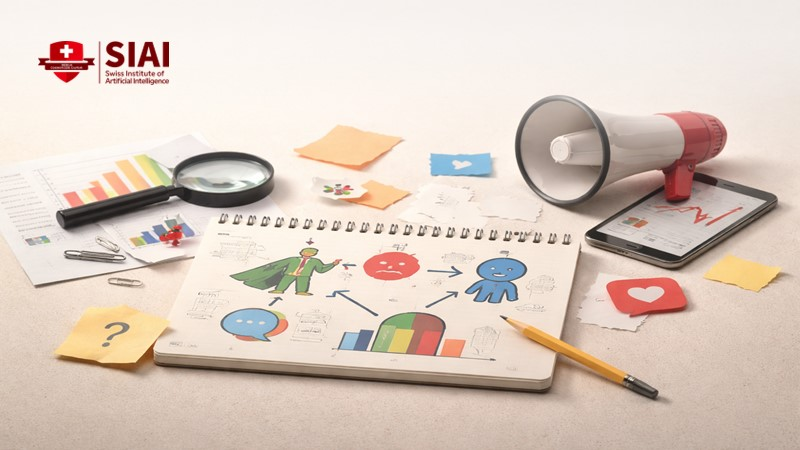
Stories outlast statistics, and feeds reward that
Viral politics runs on heroes, villains, and anger
Teach narrative literacy, and push for cleaner platform data
A study found that the impact of a statistic on belief decreased by 73% after just
Korea’s AI PhD Fast Track Won’t Fix the Talent Gap Unless It Fixes the PhD
Picture
Member for
1 year 8 months
Real name
Keith Lee
Bio
Keith Lee is Professor of AI and Finance at the Gordon School of Business, Swiss Institute of Artificial Intelligence (SIAI). His primary research lies in financial mathematics and AI-driven computational science, with a focus on quantitative modeling of complex economic and financial systems. His work integrates machine learning, stochastic modeling, and data-centric methods to study structural transformations in markets and institutions.
In recent years, his research has extended to the economic and fiscal implications of technological change, including the interaction between artificial intelligence, demographic shifts, and public finance sustainability.
He holds a PhD in Mathematical Finance from Boston University, and previously earned an MSc in Finance and Economics from the London School of Economics. He completed his undergraduate studies in Economics at Seoul National University under the Korea Foundation for Advanced Studies scholarship program.
He regularly contributes analytical essays on the broader socioeconomic implications of AI to The Economy Review.
Published
Modified
Fast AI PhDs won’t fix hiring if training stays shallow
Firms need proof of real research skills, not faster diplomas
Rigor and outcomes must drive funding and standards
Available data indicate that Korea's artificial intelligence workforce is bigger than people think. The Bank of Korea estimates that about 57,000 AI specialists were employed in Korea in 2024. Yet, companies still say they struggle to find qualified people. This gap shows the real test for the AI PhD fast-track program. If more people graduate, but hiring remains hard, the issue extends beyond the number of graduates. It relates to the suitability, knowledge, and credibility of potential employees. AI work needs a solid education. Systems can fail if the info changes. When those in charge of hiring see an AI PhD fast-track, they want proof that a person can do cutting-edge work, not just a degree earned quickly. The thinking behind the fast-track policy is that shortening the time to get a degree will attract more students. It seems simple, and the number of spots can be easily counted. But AI expertise takes time to grow in labs through coding and learning from mistakes. A PhD involves education, skill development, learning to deal with unforeseen issues, and time spent in a research setting. If the policy views the PhD as just longer schooling, the AI PhD fast track risks valuing speed over good research. The result might look good on paper, but it does not meet companies' needs.
The AI PhD fast track focuses on time, but companies want quality
In November 2025, Korea’s Education Ministry announced a nationwide plan to foster AI talent. A key part allows students to finish bachelor’s, master’s, and doctoral studies in 5.5 years. The plan also aims to increase the number of AI-focused schools from 730 to 2,000 by 2028 and to increase the number of science and special schools offering specialized courses from 14 to 27. The Korea Herald reported that about 1.4 trillion won is being invested. These numbers show the urgency and highlight what’s easiest to measure: time, numbers, and funding. Yet, employers care more about skills, judgment, and good research habits.
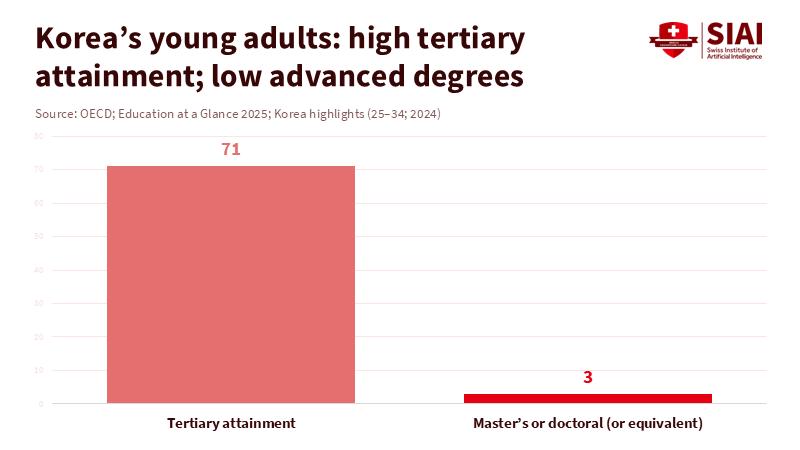
It is worth asking what the system seeks. Korea has strong educational results but relies on credentials. OECD data shows 71% of Koreans aged 25 to 34 have completed college, the highest rate among OECD countries. Only 3% of that group have a master’s or doctorate, well below the OECD average. This suggests degrees may be social symbols, while advanced study is just an addition. For the AI PhD fast-track program, that matters. It could raise the wrong question: "How fast can a student graduate?" Research should ask: "What did the student figure out, and how do we know it is correct?" If time is the primary measure, courses may cut the most challenging material, such as advanced math, statistics, and system iteration.
Figure 1: High degree completion does not automatically mean deep research training—this gap helps explain why speed-based PhD reforms can miss what employers screen for.
Public money also adds to what is at stake. Korea spends heavily on new ideas, allocating about 4.96% of its GDP to domestic R&D in 2023. With so much public support, inadequate training is more than a personal mistake; it is a loss for the country. Taxpayers pay for labs, grants, and programs to develop talent. If the AI PhD fast track leads to shallow research, companies will pay twice: first through taxes and then to fix failed systems, while graduates see their degrees mean less. Universities may also face reputational issues that are hard to fix. Speed can be helpful when it is earned through real competence and good guidance; otherwise, the program might just help people finish quickly rather than prepare them for meaningful work.
What the AI PhD fast track should provide for jobs
What companies want in AI is becoming clearer, not easier. The OECD says that in Korea, 56.5% of companies using AI have seen it replace parts of some jobs. Many also say AI has increased the types and level of skills needed for current jobs. For small to mid-size Korean businesses, the need for data examination skills is on the rise. The next need is computer skills. This tells universities designing the AI PhD fast-track that a quicker path only helps if graduates can handle complex data, create tests, and explain their decisions. This skill comes from repeatedly doing research, getting feedback, and creating tested and fixed systems. It does not come from taking courses alone.
The Bank of Korea’s research on the job market explains why more graduates do not necessarily lead to more hiring. They estimate that about 11,000 Korean AI experts worked outside Korea in 2024, about 16% of the AI workforce.
Their findings also show that AI workers' pay in Korea was only about 6% higher in 2024 than in the U.S. and other countries. When income is low, people tend to look for work elsewhere. It can also change how employers act at home. Companies raise the bar for hiring because it costs them a lot to employ someone who is not ready. They look for proof of ability, focusing on past work and solid modeling skills. In that environment, the AI PhD fast track will be tested by its results. If the degree does not point to someone who will do well on the job, it will lose value.
Estimates of job shortages show why fundamental skills matter. A 2023 forecast projected demand for AI staff to reach about 66,100 by 2027, while only about 53,300 are available, leaving a gap of roughly 12,800. SPRi stated that 81.9% of 2,354 AI firms in Korea had trouble finding enough workers. These numbers support investment but show the risk involved. Companies do not want just anyone with an AI title; they want people who can create and defend their work. One poorly skilled worker can slow a team and create hidden risks. So, the AI PhD fast track needs to raise the percentage of graduates who can contribute to research and new products from the start.
Figure 2: The headline shortage is serious, but the bigger problem is at the R&D level—exactly where a credible PhD signal should reduce risk for employers.
When speed turns into a meaningless degree
No one wants to create a worthless degree. The risk is that standards drop over time. Across the world, low-quality schools often have something in common: they promise a degree very quickly. The Council for Higher Education Accreditation warns that these schools might promise degrees in a very short period, making quick completion a main selling point. The Department of Education warns that these places may look real but fail basic quality checks, and encourages students and companies to verify claims.
Korea’s AI PhD fast track is not one of these degree mills. But local discussion already calls programs that award degrees without real training "degree mills." If 5.5 years is what it is known for and the rules are not consistent, the thinking can become flawed: students pay to save time, institutions sell degrees, and companies and taxpayers suffer when the degree does not indicate that someone is capable.
AI makes it harder to hide a poor education. A bad report might go unnoticed in some subjects, but in AI, it shows up quickly. Teams that do not comprehend testing find it hard to tell what is essential. Teams that do not understand statistics struggle with skewed results. Teams that do not understand modeling struggle to think about failures. That is why companies ask about portfolios and programs, not just grades. An AI PhD fast track can be sound, but it has to rely on proof of skill rather than time. If it takes less time and has no challenging requirements, it trains students to avoid risk, since difficult questions take longer and are more likely to be answered incorrectly. That is the reverse of how research training should be.
There is also a real cost to reputation. AI recruitment is global, and word spreads fast. Companies still judge degrees by what graduates can do, even if they never visit the school. Korea is already seeing skilled AI workers leave the country. With that said, a weak sign hurts everyone, even the best graduates. The market impacts everything, not just some departments. If the AI PhD fast track is seen as a waste of time, it can limit the chances for those it is meant to help. Therefore, consistency across institutions is essential. A few weak programs can ruin the signal for the good ones. It takes time to build a good reputation, but it can be lost quickly.
How to make the AI PhD fast track valuable for hiring
Instead of selling speed, the AI PhD fast-track should be about demonstrating skill with clear proof. Students who already have skills can move faster, but those who do should not be hurried. That requires a solid foundation in math, statistics, and modeling, which many AI research labs consider important. It also needs results that are hard to fake: tested experiments, well-documented programs, and a report that passes outside review. Schools can help by testing problem-solving skills instead of memorization. If a school cannot achieve these conditions, it should not promote itself as an AI PhD fast track.
Rules should match goals. OECD research on quality suggests that outside policies can encourage improvement inside higher education. Some might say the AI PhD fast track is only for great students so that quality will take care of itself. This will not occur when money and reputation boost productivity across departments. So, officials need rules that reward research, not just numbers. School leaders need to assign reasonable workloads that allow time for mentoring and feedback. Departments need external examiners who are not aligned with career interests. Precise results, like published work, matter too. These steps protect good students and stop companies from paying for credentials that are not credible.
The job market cannot be ignored. The Bank of Korea’s low pay rate means Korea is not valuing AI skills like other countries do. Some might argue that companies can teach what programs cannot, but fixing this is expensive. If great skill is not valued, it will be lost. Consequently, the AI PhD fast track needs a matching job plan. That could include stronger partnerships with companies, research standards, guidelines on ownership, and early job tracks that do not require talent to move abroad for good pay. Otherwise, Korea might train people quickly, pay for it publicly, and then see companies in other countries benefit. A quick degree is only one part of the plan; incentives and research also affect productivity.
The views expressed in this article are those of the author(s) and do not necessarily reflect the official position of the Swiss Institute of Artificial Intelligence (SIAI) or its affiliates.
References
Bank of Korea. (2025). Mismatches in Korea’s AI labor market (AI workforce estimate; overseas share; wage premium discussion). Council for Higher Education Accreditation. (n.d.-a). Degree mills: An old problem and a new threat. KBS World. (2025, November 10). Gov’t unveils AI education plan to nurture new talent. Korea Herald. (2025, November 10). S. Korea to foster AI talent across all stages of life. Korea.net. (2024, December 30). Domestic R&D spending as % of GDP ranked No. 2 in 2023. Lee, K. (2025a, November 12). AI시대, 고급 교육을 포기한 대학의 미래는 없다. 디 이코노미. Lee, K. (2025b, November 12). 한국 AI 연구 인력의 실상과 그 배경 (analysis of math/stat training and AI research labor markets). 디 이코노미. MK Pulse. (2023, September 1). S. Korea faces shortage of skilled workforce in key technology fields. OECD. (2025a). Artificial intelligence and the labour market in Korea. OECD. (2025b). Education at a glance 2025: Korea country note. OECD. (2025c). Ensuring quality in VET and higher education: Getting quality assurance right. SPRi (Software Policy & Research Institute). (2024). Media page entry citing results of the 2023 AI industry survey. The Korea Times. (2025, December 5). Korea sees brain drain of AI talent amid low wage premium: BOK (Yonhap). U.S. Department of Education. (2025, April 24). Diploma mills and accreditation. WIPO. (2025). Global Innovation Index 2025: Republic of Korea indicator notes.
Picture
Member for
1 year 8 months
Real name
Keith Lee
Bio
Keith Lee is Professor of AI and Finance at the Gordon School of Business, Swiss Institute of Artificial Intelligence (SIAI). His primary research lies in financial mathematics and AI-driven computational science, with a focus on quantitative modeling of complex economic and financial systems. His work integrates machine learning, stochastic modeling, and data-centric methods to study structural transformations in markets and institutions.
In recent years, his research has extended to the economic and fiscal implications of technological change, including the interaction between artificial intelligence, demographic shifts, and public finance sustainability.
He holds a PhD in Mathematical Finance from Boston University, and previously earned an MSc in Finance and Economics from the London School of Economics. He completed his undergraduate studies in Economics at Seoul National University under the Korea Foundation for Advanced Studies scholarship program.
He regularly contributes analytical essays on the broader socioeconomic implications of AI to The Economy Review.
2022 proved the nonlinear Phillips curve under tight labor
Use two-speed budgets: inflation >4% and v/u >1 trigger
Teach regime-switching to keep small misses small
When Speed Becomes Contagion: How AI Turns Local Shocks into Systemic Risk
Picture
Member for
1 year 7 months
Real name
Ethan McGowan
Bio
Professor of AI/Finance, Gordon School of Business, Swiss Institute of Artificial Intelligence
Ethan McGowan is a Professor of AI/Finance and Legal Analytics at the Gordon School of Business, SIAI. Originally from the United Kingdom, he works at the frontier of AI applications in financial regulation and institutional strategy, advising on governance and legal frameworks for next-generation investment vehicles. McGowan plays a key role in SIAI’s expansion into global finance hubs, including oversight of the institute’s initiatives in the Middle East and its emerging hedge fund operations.
Published
Modified
AI turns rumors into instant, system-wide stress
Shared models and platforms cause herding and correlated errors
Use timed frictions, model diversity, and critical-hub oversight
The most important number in finance right now is 42 billion. That's how much money one US bank saw disappear in a single day in March 2023. Another $100 billion was lined up to leave the next morning. This wasn't an old-school bank run with people lining up outside. It happened through phones, online feeds, and electronic transfers. This is how fast things can go wrong now. And it's super important to keep this in mind when we think about the risks AI creates for the financial system. AI speeds up the creation, sharing, and action on information. It can turn a rumor into a decision and a decision into a cash flow really fast. This speed is what turns normal little problems into system-wide panic. If we keep thinking of AI as just something individual companies use, rather than a connected system, we're going to get the risk wrong.
AI Risk in Finance: What Now Moves Together
The old way of thinking assumed that things slowed down between a bad story and its reaction. AI gets rid of that slowdown. It makes finding patterns, automating decisions, and coordinating actions faster because everyone's using the same information, models, and platforms. This means everything is really tightly linked together. Depositors and traders see the same stuff at the same time and use similar tools to react. Back in March 2023, that bank lost $42 billion in eight hours, and $100 billion was waiting to get out the next day. Regulators later realized that social media and online channels made the problem much worse. That speed isn't unusual anymore; it's just how things are with AI risk in finance when things go bad.
It's not just about speed; it's that everyone's doing the same thing. Lots of companies now use similar AI services, cloud services, data providers, and model designs. Regulators are warning that this can cause everyone to act the same way and make the same mistakes, especially if the models are hard to understand or poorly managed. If you add AI-powered news feeds and ad targeting, a random social media post can cause people to pull their money out of a bank, or a bad risk score can cause everyone to sell at once. The way modern finance is set up – with all these connections – turns acting alike into acting fast. That's why we need to manage AI risk in finance like a network issue, not just an issue with individual models.
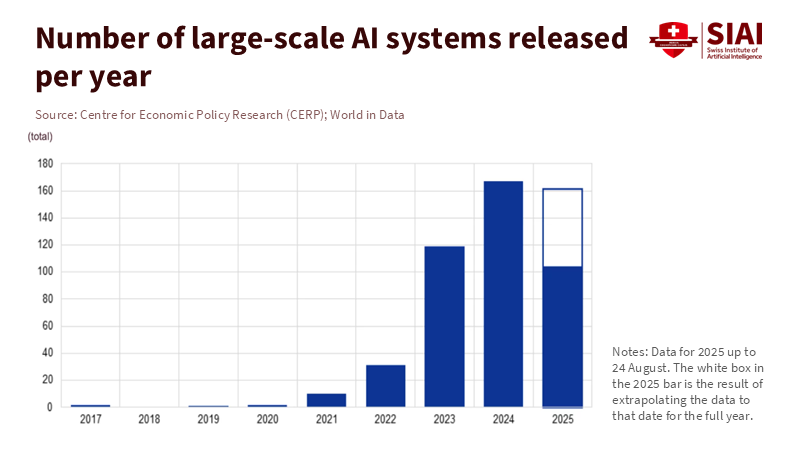
Figure 1: Model releases exploded after 2022, pushing common exposure and synchronous behavior across firms—an upstream driver of AI systemic risk.
Five Things That Cause AI Risk in Finance
First, AI-driven fake news can now actually hurt a company's bottom line. The bank runs in 2023 showed how social media and online banking accelerated the process. Banks with high Twitter activity lost more money when SVB failed, revealing their stress in real time. Payment data show that at least 22 US banks saw people withdraw a large amount of money that month. New tests show AI-generated false claims about a bank's safety, spread through cheap ads, can really make people want to move their money. Almost 60% of people surveyed said they'd think about moving their money after seeing something like that. Deepfakes make it even easier to trick companies. Earlier this year, a finance employee was tricked into sending about $25 million to scammers by a deepfake video call. The main point is: AI in finance means bad news doesn't just scare the markets; it moves money.
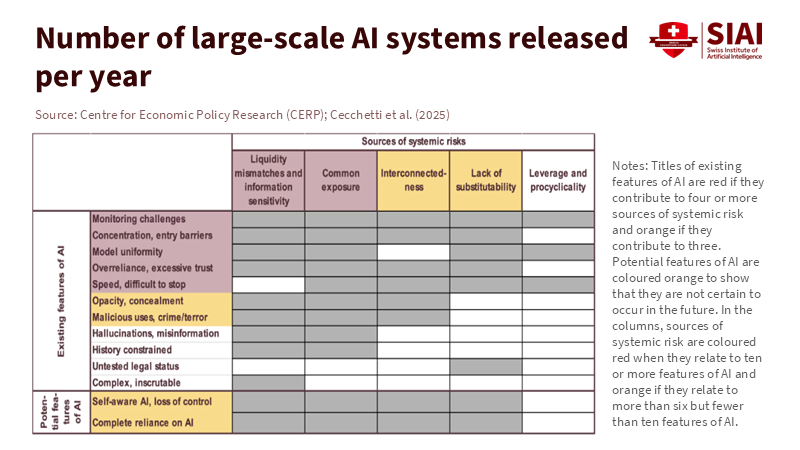
Figure 2: Speed, opacity, and model uniformity hit multiple risk channels at once (liquidity, common exposure, interconnectedness, substitutability, leverage), explaining why rumor-driven shocks scale so fast.
Second, if everyone uses the same models, they're more likely to make the same mistakes. The idea is simple: if everyone's connected and getting the same information, it can cause a domino effect. What's new is that everyone may be using the same kinds of models, data, and tech companies. Regulators are warning that AI can make everyone act the same way, making things more fragile, especially if the models are hard to understand and use data that is similar. As AI systems shape news and even internal memos, the same explanations pop up everywhere. Credit, risk, and trading teams then react in unison. This can cause the whole market to swing in one direction. When things change, money can disappear fast. This isn't theoretical. This is how AI risk in finance is most likely to show up – quietly at first and then exploding when things get stressful.
Third, if a few companies have a lot of control and everyone relies on their stuff, it creates single points of failure. AI runs on a small number of giant cloud and model platforms, often owned by the same companies. Authorities are starting to regulate these companies. The UK's rules for these companies went into effect this year. The EU is now directly monitoring essential tech providers and has designated central cloud and data firms as critical to the financial sector. This is because if a major vendor has a problem, it can spread to lots of institutions at once. If everyone's using the same AI tools, a simple failure or cyberattack can cause market-wide issues even if the banks themselves do everything right.
Fourth, if the data and models are weak, it can cause widespread errors. AI systems are only as good as the data and security they have. National standards groups are warning about hacking techniques that can secretly change results or steal information. Explainability remains limited for many advanced models. This leads to mistakes, especially when things change. Earlier this year, the UK warned that hacking risks might never be fully fixed in current AI models. This means the risk has to be managed. If several institutions use similar models and data and face the same hacking attempts, they'll make the same mistakes. AI risk then goes from being small to being huge – thousands of small, fast errors that all point in the same direction.
Fifth, speed and money are colliding. AI shrinks the time between getting a signal and settling a transaction. This is helpful when things are calm, but risky when things are stressful. What happened in March 2023 is now the example: one bank lost about a quarter of its deposits in a day. Also, deposit amounts and market values fluctuated throughout the day in response to what people were saying online. European authorities are learning the same thing: instant payments and mobile banking mean bank runs happen in hours, not days. In the markets, AI tools can cause everyone to sell at once, leading to low prices. The reason is simple: when everyone acts fast and in the same way, there isn't enough money to go around. This is the core of AI risk in finance.
What to Do About AI Risk in Finance
The first thing we need is a rule for handling transactions when rumors are spreading. Faster isn't always safer. The goal isn't to stop speed but to control it. A memo suggested common-sense rules: slow down big withdrawals when regulators are about to make an announcement, pause automated selling programs when there are information circuit-breaker alerts, and require banks, platforms, and authorities to track down rumors in real time. The same idea should apply to both regular customers and businesses. If AI risk grows when everyone uses the same fast tools at once, the solution is to slow things down for a bit so authorities have time to determine what's true and keep things stable.
The second thing is to strengthen the systems that make AI common. Watch critical third-party companies and ensure they're resilient, secure, and able to recover from problems. Run exercises that involve the entire sector, assuming that models have been compromised or that cloud services are down. Map out the shared connections, not just who uses which vendor. Require institutions to have multiple models for critical functions, with distinct data and decision-making processes, to reduce the risk of everyone doing the same thing. Update stress tests to include AI-driven fake-news scenarios with short deadlines and deposit losses, based on events in 2023. Regulators should also require official statements to be verified with digital signatures so that platforms and media can stop fake news in real time.
What Teachers and Leaders Should Do Next
Courses need to keep up with how AI changes risk in finance. Teach the new math of bank runs. Show how things like uninsured deposits, social media, and instant payments combine to cause money to flow out of banks. Assign readings that cover finance, cybersecurity, and communications. Students should look at the 2023 events to see the speed and how stress is spread. They should simulate rumor-driven panics and then see how slowing down transactions and sending explicit messages from regulators changes the outcome. The goal isn't to scare people; it's to prepare them.
Within institutions, leaders should develop joint plans across teams such as treasury, risk, communications, legal, and security. These teams need to quickly spot fake media, send verified statements across channels, and work with platforms to remove harmful phony news. They should also check their own AI systems for shared weaknesses, such as identical models, data vendors, or setups. Test AI agents against hacking. Maintain break-glass manual options for essential flows. This doesn't slow down innovation. It keeps it going by making sure that one clever hack or one lie can't bring the whole system down.
The $42 billion day isn't just a number to remember. It's a constraint. We have a financial system where information moves at model speed, and money follows right behind. That's not going to change. What can change is how we handle the stress. AI risk in finance is a network problem: standard tools, data, vendors, and stories. The solutions need to be network-aware: slowing money flows when rumors spread, supervising key infrastructure, using different models for important decisions, and sending fast, verified messages to fight fake news. Teachers should train for these situations. Policymakers should create rules and test them. Bank leaders should practice them. We don't have to accept that every rumor turns into a bank run. If we build safeguards that work at the speed of AI, then the next $42 billion day can be something we've moved past.
The views expressed in this article are those of the author(s) and do not necessarily reflect the official position of the Swiss Institute of Artificial Intelligence (SIAI) or its affiliates.
References
Banque de France. (2024). Digitalisation—A potential factor in accelerating bank runs? Bloc-notes Éco. Bank of England; Prudential Regulation Authority; Financial Conduct Authority. (2024). Operational resilience: Critical third parties to the UK financial sector (PS16/24). Bank for International Settlements. (2024). Annual Economic Report 2024, Chapter III: Artificial intelligence and the economy: Implications for central banks. Bank for International Settlements—Financial Stability Institute. (2023). Managing cloud risk (FSI Insights No. 53). California Department of Financial Protection and Innovation. (2023). Order taking possession of property and business of Silicon Valley Bank. Cipriani, M., La Spada, G., Kovner, A., & Plesset, A. (2024). Tracing bank runs in real time (Federal Reserve Bank of New York Staff Report No. 1104). Cookson, J. A., Fox, C., Gil-Bazo, J., Imbet, J.-F., & Schiller, C. (2023). Social media as a bank run catalyst (working paper). European Systemic Risk Board—Advisory Scientific Committee. (2025). AI and systemic risk. Financial Stability Board. (2024). The financial stability implications of artificial intelligence. Fenimore Harper & Say No to Disinfo. (2025). AI-generated content and bank-run risk: Evidence from UK consumer tests. Federal Reserve Board Office of Inspector General. (2023). Material loss review: Silicon Valley Bank. National Institute of Standards and Technology. (2023). AI Risk Management Framework (AI RMF 1.0). National Institute of Standards and Technology. (2024). Generative AI: Risk considerations (NIST AI 600-1). National Cyber Security Centre (UK). (2025). Prompt injection is not SQL injection (it may be worse). Reuters. (2024). Yellen warns of significant risks from AI in finance. Reuters. (2025). EU designates major tech providers as critical third parties under DORA. Swiss Institute of Artificial Intelligence. (2025). Digital bank runs and loss-absorbing capacity: Why mid-sized banks need bigger buffers. VoxEU/CEPR Press. (2025). AI and systemic risk. World Economic Forum. (2025). Cybercrime lessons from a $25 million deepfake attack.
Picture
Member for
1 year 7 months
Real name
Ethan McGowan
Bio
Professor of AI/Finance, Gordon School of Business, Swiss Institute of Artificial Intelligence
Ethan McGowan is a Professor of AI/Finance and Legal Analytics at the Gordon School of Business, SIAI. Originally from the United Kingdom, he works at the frontier of AI applications in financial regulation and institutional strategy, advising on governance and legal frameworks for next-generation investment vehicles. McGowan plays a key role in SIAI’s expansion into global finance hubs, including oversight of the institute’s initiatives in the Middle East and its emerging hedge fund operations.
Tariffs buy learning time but, in tight supply chains, hit households first
Protection works only when narrow, temporary, and performance-tied with investment
Technological hegemony comes from factories and exports; tariffs are a short clock
The Tools Will Get Easier. Directing Won’t: AI Video Streaming’s Real Disruption
Picture
Member for
1 year 7 months
Real name
Catherine McGuire
Bio
Professor of AI/Tech, Gordon School of Business, Swiss Institute of Artificial Intelligence
Catherine McGuire is a Professor of Computer Science and AI Systems at the Gordon School of Business, part of the Swiss Institute of Artificial Intelligence (SIAI). She specializes in machine learning infrastructure and applied data engineering, with a focus on bridging research and large-scale deployment of AI tools in financial and policy contexts. Based in the United States (with summer/winter in Berlin and Zurich), she co-leads SIAI’s technical operations, overseeing the institute’s IT architecture and supporting its research-to-production pipeline for AI-driven finance.
Published
Modified
AI video streaming is mainstream; tools are easier, directing still matters
Without rights, provenance, and QC, slop scales and trust falls
Train hybrids and set standards to gain speed without losing story
Back in December 2025, everyone's jaw dropped when OpenAI and Disney made a deal: a cool $1 billion investment for a three-year license to use over 200 characters from Disney, Marvel, Pixar, and Star Wars in OpenAI's Sora. This shows two big things. First, AI video isn't just some experiment anymore; it's a real way to get content out there, complete with familiar characters and a way to get right into people's homes. Second, just because making videos is getting easier doesn't mean they'll be better. We're going to see way more videos that seem like content, act like content, and please algorithms like content—but totally miss the mark on story, morals, and good filmmaking. This isn't meant to bash AI video. It's just a reminder to treat it like a new type of camera, not a replacement for the director. People have already shown they're wary: surveys from 2024 and 2025 showed that most folks are uneasy about media made by AI. If AI video takes off without any rules, quantity will win over quality. But if we design things right, we can lower costs and risks while actually improving stories.
AI video is a revolution in tools, not in talent
The tech has definitely gotten better: models can now make short, decent-quality videos in seconds, remix footage, and keep things looking consistent. Studios and streamers aren't just playing around anymore; they're making rules about when and how to use these tools in productions. The industry is adopting this stuff quickly; by mid-2024, most firms said they use AI all the time. Surveys in 2025 showed that media companies are investing more in AI across the board, from planning stories to adding effects and translating content. This is a big deal. It's a fundamental change in tools that speeds up the process and makes it cheap to try new things. But it’s still just about the tools. The important stuff—like taste, structure, pacing, acting, and ethics—still needs a human. You can't solve those problems with a simple prompt. It takes the same good judgment that has always made movies watchable.
This upcoming trend will be like what happened with data: people who could use powerful software but didn't know enough to design good studies. They could get results fast, but they weren't always accurate. With video, we'll have people who can put scenes together but don't know much about directing. That doesn't mean their work is useless. It just means the industry needs to think about what success looks like. Think of it like power steering, not autopilot. These tools make it easier to turn the wheel, but they don't decide where to go or how to handle curves. If we think that easier is better, we'll end up with a bunch of almost-good movies that feel empty. And because AI-generated videos send this straight to viewers, mistakes become a much bigger problem.
AI video needs some professional help to be good
We've already seen examples of this. Netflix has been using AI for a while, like for creating anime backgrounds and testing AI lip-sync and effects. These are small jobs within a bigger process, not a total robotic takeover. The benefit is in the small stuff: cleaning up images, translation, and timing. Streamers and studios have also released rules for using AI. This is how it should work: humans directing, machines helping, and everything documented. AI video can be great for short fan clips or controlled story experiments that don't confuse people.
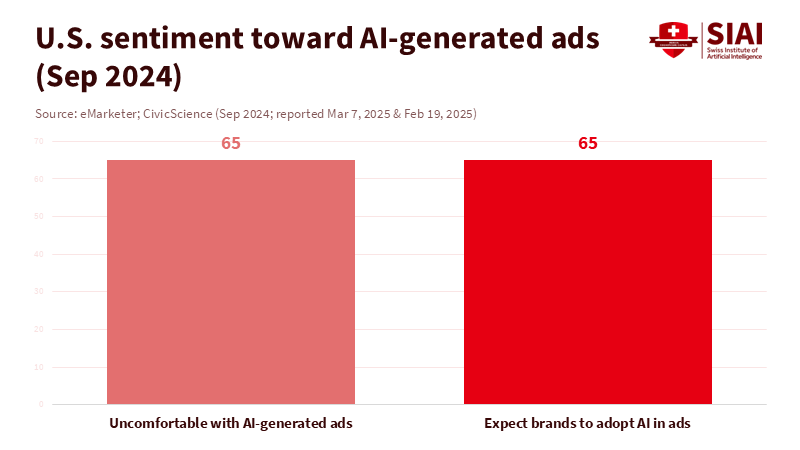
The risks are also obvious. People don't like destructive AI content. A 2025 study found that most viewers are uncomfortable with AI-generated media. People are already used to scrolling past low-quality content. This problem will definitely get worse as AI-generated video tries to tell longer stories. Viewers will forgive mistakes in a short video, but they won't be so forgiving if a movie has bad acting, a weird story, or bad lip-sync for 45 minutes. Having a process allows standards to be established: quality checks to ensure everything looks right and to compare performance to the story. AI can create a room, but it can't tell you if it feels real.
Figure 1: Discomfort is high—but so is the expectation that brands will use AI anyway.
AI video will affect money, rights, and how things are distributed
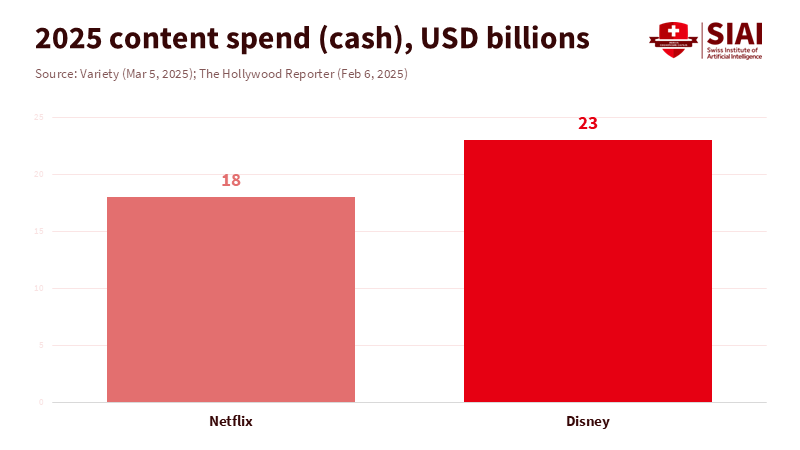
Pay attention to where the money goes. The top companies are spending a ton on content: the top six spent around $126 billion in 2024. Some companies are spending even more: Netflix is planning about $18 billion in 2025, and Disney is projecting around $24 billion in 2026. AI tools can cut post-production time, reduce the need for re-shoots, and translate things into other languages without hiring more people. It also opens up new opportunities for ads. The entertainment industry is expected to generate around $3.5 trillion, with more ads shown on streaming services and targeted by AI. AI-generated video fits here: use short clips to pique interest, create dynamic ads, and test new ideas.
Rights protection will be key. The Disney–OpenAI deal sets out the idea: license characters, not actor appearances; control distribution through an approved channel; and ensure everything is safe. This is how big companies will control AI media: by letting fans play within certain limits. For policy, this means better watermarks, clear information, and good communication between tools. For unions, this means contracts that protect actors' consent and payment when AI uses their faces or voices. It also means labels that viewers understand. If AI video is going to catch on, it needs to be cheap and have clear rights rules.
How educators and politicians should control AI video
Education needs to change now. Film schools need three tracks. First, teaching directing by using AI tools as cameras. Students should still learn the basics of storytelling and how to use AI to plan shots. Second, a track that covers the ins and outs of AI models, data ethics, and automation. Graduates should know as much about color correction as they do about lenses. Third, a policy track that treats AI video as a social problem: important disclosures, safe watermarks, and fair boundaries that can be taught to everyone. This doesn't replace writing, acting, or camera work. It prepares them for the machines that are now part of how stories are told.
For administrators, the choices are immediate. Get tools that show where content came from. Ensure that any use of AI is clearly stated in the paperwork. Check for AI-created faces and voices, and get the people's approval. Run pilot projects that pair students with industry mentors to test AI: human writing, AI planning, human filming, AI edits, and human mixing. Measure the results: time saved, quality differences, and how people respond. For politicians, the focus should be realistic. Require clear labels for AI media and ensure they're on content for kids. Update worker contracts so that AI is used by professionals, not as a way to cut jobs. Research how to measure video quality so we aren't just judging things by clicks. Make AI video boring: safe and reliable.
The rules we make now will decide what we watch later
The first thing I said—$1 billion and 200 characters—shows that AI video is going to be a popular template. The tech will only get easier. That doesn't mean anyone can be a director. It means it's easier to reach a first version of a video, making what happens next even more important. If we focus on quantity over quality, people will lose interest. If we set standards for craft, consent, and content source, we can open things up more while protecting good storytelling. Schools can train hybrid storytellers. Administrators can find safe tools. Politicians can set strong guidelines. What we see in the future will depend on the choices we make today. Treat AI video as a new instrument. Keep a human in charge. And judge success the same way: whether the story sticks with us when the screen goes black.
The views expressed in this article are those of the author(s) and do not necessarily reflect the official position of the Swiss Institute of Artificial Intelligence (SIAI) or its affiliates.
References
Ampere Analysis. (2024, October 29). Top six global content providers account for more than half of all spend in 2024. Autodesk. (2025, August 15). Spotlight on AI in Media & Entertainment (State of Design & Make, M&E spotlight). Barron’s. (2025, December). Disney and OpenAI are bringing Disney characters to the Sora app. Bloomberg. (2025, December 11). Disney licenses characters to OpenAI, takes $1 billion stake. Bloomberg. (2025, December 19). Inside Disney and OpenAI’s billion-dollar deal (The Big Take). Deloitte. (2025, March 25). Digital Media Trends 2025. Disney (The Walt Disney Company). (2025, December 11). The Walt Disney Company and OpenAI reach agreement to bring Disney characters to Sora (press release). eMarketer. (2025, March 7). Most consumers are uncomfortable with AI-generated ads. McKinsey & Company. (2024, May 30). The state of AI in early 2024. Netflix Studios. (2025). Using Generative AI in Content Production (production partner guidance). OpenAI. (2024, December 9). Sora is here (launch announcement; 1080p, 20-second generation). PwC. (2025, July 24). Global Entertainment & Media Outlook 2025–2029 (press release and outlook highlights). Reuters. (2025, July 30). Voice actors push back as AI threatens dubbing industry; Netflix tests GenAI lip-sync and VFX. Reuters. (2025, December 11). Disney to invest $1 billion in OpenAI; Sora to use licensed characters in early 2026. Variety. (2025, March 5). Netflix content spending to reach $18 billion in 2025. The Hollywood Reporter. (2024, November 14). Disney expects to spend $24 billion on content in fiscal 2025. The Hollywood Reporter. (2025, December). How Disney’s OpenAI deal changes everything. The Verge. (2024, December 9). OpenAI releases Sora; short-form text-to-video at launch.
Picture
Member for
1 year 7 months
Real name
Catherine McGuire
Bio
Professor of AI/Tech, Gordon School of Business, Swiss Institute of Artificial Intelligence
Catherine McGuire is a Professor of Computer Science and AI Systems at the Gordon School of Business, part of the Swiss Institute of Artificial Intelligence (SIAI). She specializes in machine learning infrastructure and applied data engineering, with a focus on bridging research and large-scale deployment of AI tools in financial and policy contexts. Based in the United States (with summer/winter in Berlin and Zurich), she co-leads SIAI’s technical operations, overseeing the institute’s IT architecture and supporting its research-to-production pipeline for AI-driven finance.