Education

AI today is pattern-matching, not reasoning—resist AGI hype Redesign assessments for explanation, sources, and uncertainty Procure on outcomes and risk logs; keep humans in charge The core challenge facing schools this year
Read More
Use space data centers to ease Earth’s compute and water strain—start with education Run low-latency classroom inference in LEO; keep training and sensitive data on Earth Pilot with strict SLAs, life-cycle audits, and debris plans before scaling
Read More
AI slop is flooding education and hiring, drowning out real skill Fix the system by verifying process—observed writing, evidence-linked claims, and a short oral defense Set provenance standards and incentives so accountable, source-grounded work beats paste
Read More

Export controls slow foes, not secure leadership Invest in compute, clean power, talent Make NAIRR-style Compute Commons permanent U.S. data centers used about 183 terawatt-hours of electricity in 2024, roughly 4% of total U.S.
Read More











Defense AI education is the bottleneck between record defense spending and real capability Train stack-aware teams with mission credentials Scale safely with oversight and shared compute In 2024, global military spendi
Read More
Agent AI is uneven—pilot before student use Start with internal, reversible staff workflows, add human-in-the-loop and logs Follow EU AI Act/NIST; publish metrics; scale only after proof School leaders should pay attention to
Read More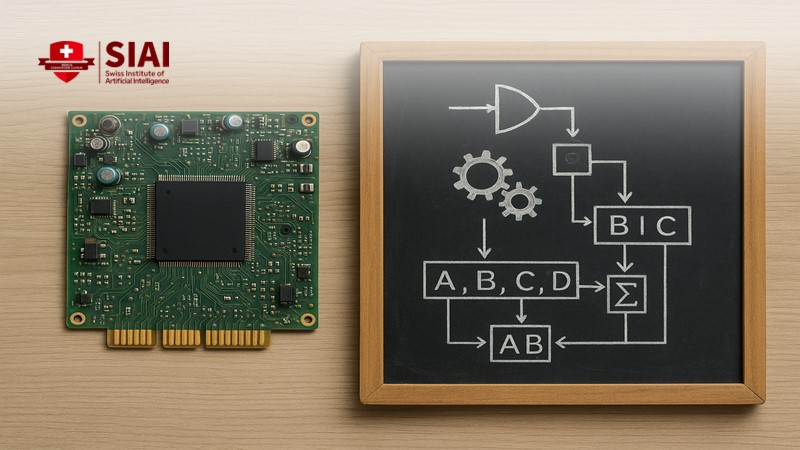
Today’s AI is costly and brittle; schools need symbolic AI Hybrid neuro-symbolic tools show each step, making feedback and grading fair Policy should fund open subject rules and buy systems that prove their logic
Read More
Sovereign AI is public infrastructure for education Countries blend open models and public compute to localize and cut dependence Schools need shared data, transparent tests, and energy-smart procurement In late 2025, South Korea annou
Read More
AI in education is pattern matching, not true thinking The danger is confusing correlation with real causal insight Schools must demand causal evidence before using AI in high-stakes decisions In 2025, a national survey in the Uni
Read More



Deepfake image rights alone cannot stop fast, zero-cost copying of abusive content We need layered protection that combines law, platform duties, and strong school-level responses Education systems must train students and staff, act quickly on reports, and treat synthetic abuse as a shared responsibility
Read More

Spatial intelligence in education measurably boosts maths and STEM outcomes Use world models, but prioritize curriculum, tasks, and teacher practice Fund weekly spatial lessons and assess visual reasoning to scale
Read More

AI capital cheapens routine thinking and shifts work toward physical, contact-rich tasks Gains are strong on simple tasks but stall without investment in real-world capacity Schools should buy AI smartly, redesign assessments, and fund high-touch learning
Read More
Optimization isn’t segregation Impose variance thresholds and independent audits Require delivery reports and fairness controls The key statistic in the public debate isn't about clicks or conversions.
Read More
AI chatbots in education are mediators now, not replacements Set guardrails: upstream uses, training, human escalation, and source transparency Prepare for embodied systems next while protecting attention, care, and truth
Read More
AI spending is soaring, but unit economics remain weak for education Rising data-center capex and power costs will push up subscription and utility bills Schools should buy outcomes, not hype—tie payments to verified learning gains
Read More
Mind captioning maps visual brain patterns to text, but it’s pattern recognition—not mind reading In schools, keep it assistive only, with calibration, human-in-the-loop checks, and clear error budgets Adopt strict governance first: informed consent, mental-privacy protections, and audited model cards
Read More