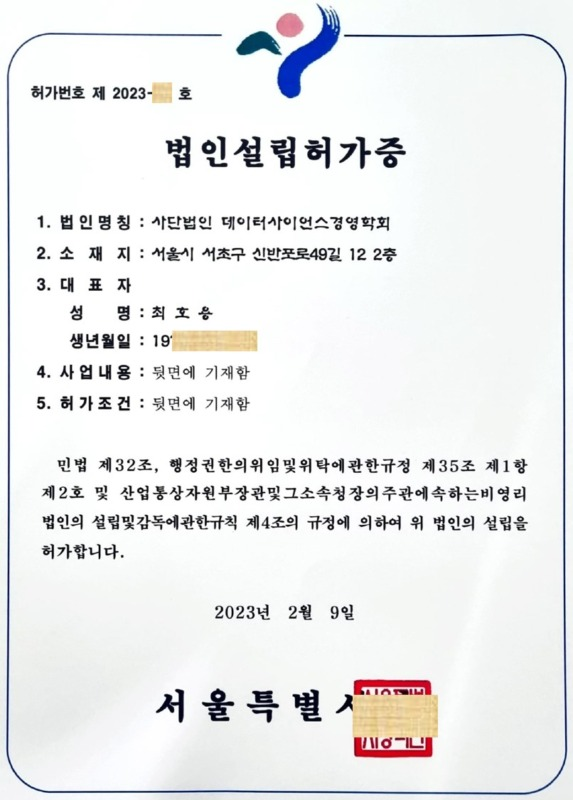
The Managerial Data Science Association (MDSA), chaired by KAIST technology management professor Ho-yong Choi, announced on February 9 that it had received permission to establish an incorporated association from Seoul City Hall. Subsequently, the corporation was established on March 9th.
KAIST technology management professor Choi Ho-yong, president of the society, as well as Kookmin University College of Economics professor Kim Jae-jun and Korea University technology management professor Kim Jong-myeon were appointed as directors. In addition, Professor Kyunghwan Lee of the Swiss Institute of Artificial Intelligence (SIAI), director of the Global Institute of Artificial Intelligence (GIAI) research institute, will serve as auditor.
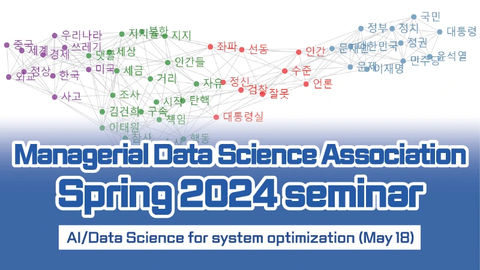
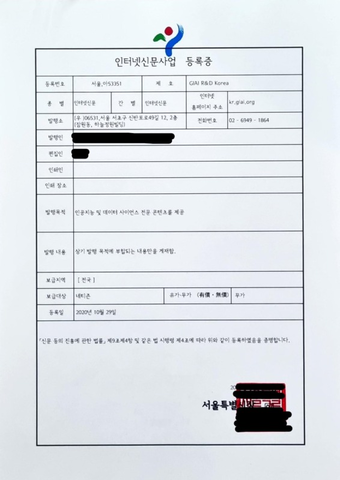
With the private contribution of SIAI Professor Gyeong-hwan Lee, MDSA will operate a specialized journal under the academic society from April 1st. The first seminar after the establishment of the corporation is scheduled to be held in May.
Public Interaction & Corrections Report — The Economy (2022)
Picture
Member for
1 year 8 months
Real name
GIAI Admin
Bio
GIAI Admin represents the official administrative voice of the Gordon Institute of Artificial Intelligence (GIAI). This account manages institutional communications, announcements, and operational updates across GIAI’s research, education, and global initiatives.
Published
Updated
Entity: The Economy
Reporting Period: January–December 2022
Report Type: Public Response, Corrections, and Behavioral Signals
Disclosure Level: Public Summary
1. Purpose
This report summarizes how The Economy was received by its audience during year 2022, including corrections, user responses, and observable behavioral patterns. It serves as a feedback layer distinct from internal editorial evaluation.
2. Scope of Review
This report covers:
Published corrections and content revisions
Audience engagement patterns (aggregated)
Qualitative response signals
Structural user behavior trends
Excluded:
Individual user identities
Platform-specific analytics details
Moderation logs and internal response handling
3. Key Developments
No major retractions were issued during the reporting period
Minor corrections were made primarily for clarity and structural consistency rather than factual error
Audience engagement remained concentrated on legacy content and region-specific material
Limited but consistent interaction observed on newly structured English-language content
4. Corrections & Revisions Summary
Corrections during this period were limited in scope and fell into the following categories:
Clarification Edits: Refinement of wording or structure
Categorization Adjustments: Reclassification of articles into appropriate sections
Formatting Standardization: Alignment with updated editorial templates
No corrections involving material factual inaccuracies were formally recorded in this period.
5. User Behavior Observations
A significant proportion of traffic continues to originate from previously published legacy content
Newly structured content shows lower immediate engagement but higher consistency in reading patterns
Regional segmentation of audience behavior remains pronounced, particularly in Korean-language traffic
Engagement depth (time-on-page, scroll patterns) suggests selective but focused readership rather than broad casual consumption
6. Qualitative Response Signals
Limited direct user feedback was received through formal channels
External reactions, where observable, indicate:
Recognition of a shift toward more structured and institutional tone
Reduced emotional engagement compared to earlier content phases
Ambiguity in distinguishing between opinion and analysis in certain articles
7. Observations
There exists a structural mismatch between legacy audience expectations and current editorial positioning
Transition toward a more institutional tone may reduce short-term engagement while increasing long-term credibility
The absence of strong reactive feedback may reflect either limited reach or deliberate audience filtering
8. Outstanding Issues
Lack of a formalized public feedback integration mechanism
Continued dependence on legacy content for visibility
Limited transparency in correction policy from a user perspective
Absence of clearly communicated content classification to readers
9. Next Steps
Formalization of a publicly accessible corrections policy
Gradual alignment of legacy content with current editorial standards
Exploration of structured feedback channels
Continued monitoring of engagement patterns across language segments
10. Governance Note
This report is based on aggregated and anonymized observations of user interaction. Detailed analytics, individual responses, and moderation processes are not disclosed for privacy and operational reasons.
Picture
Member for
1 year 8 months
Real name
GIAI Admin
Bio
GIAI Admin represents the official administrative voice of the Gordon Institute of Artificial Intelligence (GIAI). This account manages institutional communications, announcements, and operational updates across GIAI’s research, education, and global initiatives.
Annual Research Activity & Standards Report — SIAI Research (2022)
Picture
Member for
1 year 8 months
Real name
GIAI Admin
Bio
GIAI Admin represents the official administrative voice of the Gordon Institute of Artificial Intelligence (GIAI). This account manages institutional communications, announcements, and operational updates across GIAI’s research, education, and global initiatives.
Published
Updated
Entity: SIAI Research
Reporting Period: January–December 2022
Report Type: Research Activity & Standards
Disclosure Level: Public Summary
1. Purpose
This report provides an annual overview of research activities conducted under SIAI Research during year 2022. It outlines key developments in research direction, methodological practices, and internal standards, while maintaining necessary confidentiality regarding project-specific details.
2. Scope of Review
This report covers:
Research activity across core thematic areas
Methodological development and application
Internal review and quality control processes
Research outputs and structural evolution
The following are excluded:
Client-specific or commissioned project details
Ongoing or incomplete research work
Proprietary data sources and technical implementations
3. Research Themes & Direction
During this period, SIAI Research maintained focus on the following areas:
Structural inefficiencies in education and labor systems
Applied analytics in emerging domains (including experimental programs)
Research direction remained aligned with institutional priorities, emphasizing interpretability, structural insight, and applied relevance over purely technical optimization.
4. Key Developments
Consolidation of research activity under a unified SIAI Research identity
Increased integration between research outputs and institutional applications (e.g., education, rankings)
Refinement of internal methodological frameworks for consistency across projects
Reduction of fragmented or exploratory work not aligned with core research direction
5. Operational Summary
Research activities were conducted through a hybrid model combining:
Internal research development
Applied project-based analysis
Integration with educational outputs (where appropriate)
No formal expansion of research personnel was undertaken during this period. Research remained centrally directed, with selective external collaboration.
Project execution emphasized structured analysis and repeatable frameworks rather than one-off studies.
6. Standards & Methodology
SIAI Research continued to operate under the following principles:
Structural Clarity: Emphasis on explainable and interpretable models
Methodological Consistency: Reuse of frameworks across domains
Separation from Narrative: Distinction between research outputs and editorial interpretation
Controlled Disclosure: Limited exposure of underlying methodologies in public outputs
Internal review processes remained informal but systematic, with research outputs undergoing centralized validation prior to external use.
7. Observations
Research output has become more structurally consistent, though still dependent on centralized direction
Methodological reuse has improved efficiency but may limit exploratory diversity
Integration with institutional applications (education, rankings) has increased relevance but introduces boundary considerations
Absence of a formal peer-review structure limits external validation
8. Actions Taken
Standardization of research output formats
Alignment of research themes with institutional priorities
Reduction of non-core experimental research activity
Increased separation between research and editorial outputs
9. Outstanding Issues
Lack of formalized external review or peer validation mechanisms
Continued reliance on centralized research direction
Limited documentation of methodologies for external transparency
Potential overlap between applied research and institutional outputs
10. Next Steps
Exploration of structured review mechanisms (internal or advisory-based)
Further codification of methodological frameworks
Selective expansion of research collaboration
Continued refinement of boundaries between research and other institutional functions
11. Governance Note
This report provides a high-level summary of research activity. Detailed methodologies, data sources, and project-specific implementations are not disclosed due to confidentiality and institutional considerations.
Picture
Member for
1 year 8 months
Real name
GIAI Admin
Bio
GIAI Admin represents the official administrative voice of the Gordon Institute of Artificial Intelligence (GIAI). This account manages institutional communications, announcements, and operational updates across GIAI’s research, education, and global initiatives.
GIAI Admin represents the official administrative voice of the Gordon Institute of Artificial Intelligence (GIAI). This account manages institutional communications, announcements, and operational updates across GIAI’s research, education, and global initiatives.
Published
Updated
Entity: Mathematical Data Science Association (MDSA)
This report outlines the internal evaluation framework, methodological principles, and review processes maintained by MDSA during 2022. It also reflects on the consistency and limitations of its own evaluation practices.
2. Scope of Review
This report covers:
Evaluation methodologies applied across institutional reviews
Internal consistency of assessment criteria
Structural development of review frameworks
Meta-evaluation of MDSA’s own processes
Excluded:
Case-specific evaluation details
Individual reviewer deliberations
Raw assessment materials
3. Evaluation Framework Overview
MDSA’s evaluation model is structured around four core dimensions:
Structural Coherence (alignment between stated purpose, operations, and outputs)
Standards Consistency (uniformity of criteria across time and entities)
Functional Separation (clarity between research, education, editorial, and other roles)
Governance Integrity (presence and enforcement of internal control mechanisms)
These dimensions are applied qualitatively rather than through fixed scoring systems.
4. Methodological Approach
MDSA continued to apply a framework-based, non-quantitative evaluation model, characterized by:
Comparative assessment across reporting periods
Emphasis on structural evolution rather than static metrics
Use of institutional signals (consistency, alignment, boundary clarity)
Controlled subjectivity, anchored in predefined evaluation dimensions
No formal numerical scoring system was introduced during this period.
5. Key Developments
Refinement of evaluation dimensions to improve cross-entity comparability
Increased emphasis on functional separation as a core assessment criterion
Standardization of evaluation report structure across reviewed entities
Initial development of internal documentation for evaluation consistency
6. Observations
Evaluation outcomes remain influenced by centralized interpretation rather than distributed review mechanisms
Absence of quantitative metrics limits comparability but preserves flexibility
Framework clarity has improved, though documentation remains incomplete
Evaluation processes are consistent in principle but vary in execution depth
7. Internal Consistency Review
MDSA conducted a limited internal review of its own outputs:
Structural consistency across reports: moderate
Alignment with stated evaluation dimensions: generally maintained
Variation in depth and rigor: observable across cases
No formal external validation of MDSA methodology was conducted during this period.
8. Actions Taken
Formalization of core evaluation dimensions
Alignment of report structures across evaluations
Reduction of ad hoc evaluation approaches
Initial drafting of internal methodological notes
9. Outstanding Issues
Lack of fully documented evaluation methodology
Dependence on centralized evaluative judgment
Absence of peer or external validation mechanisms
Limited transparency of evaluation criteria to external audiences
10. Next Steps
Further documentation of evaluation framework and criteria
Exploration of partial standardization without rigid scoring systems
Consideration of advisory or peer input mechanisms
Continued refinement of cross-entity comparability
11. Governance Note
This report summarizes MDSA’s internal methodology at a structural level. Detailed evaluation criteria, deliberation processes, and internal materials are not disclosed to preserve independence and methodological integrity.
Picture
Member for
1 year 8 months
Real name
GIAI Admin
Bio
GIAI Admin represents the official administrative voice of the Gordon Institute of Artificial Intelligence (GIAI). This account manages institutional communications, announcements, and operational updates across GIAI’s research, education, and global initiatives.
GIAI Admin represents the official administrative voice of the Gordon Institute of Artificial Intelligence (GIAI). This account manages institutional communications, announcements, and operational updates across GIAI’s research, education, and global initiatives.
Published
Updated
Entity: The EduTimes
Reporting Period: January–December 2022
Report Type: Editorial Operations & Standards
Disclosure Level: Public Summary
1. Purpose
This report provides a consolidated internal review of editorial operations and standards within The EduTimes during year 2022. It reflects on structural consistency, editorial discipline, and alignment with institutional positioning.
2. Scope of Review
This review covers:
Editorial workflow and publication processes
Structural alignment of content categories
Editorial standards and consistency
Contributor management and content control
Excluded:
Source attribution and investigative methods
Pre-publication editorial deliberations
Internal personnel evaluations
3. Key Developments
Transition toward a unified editorial taxonomy across all sections
Formal separation between narrative journalism and analytical/research outputs
Increased enforcement of tone standardization, particularly in English-language content
Reduction of regionally biased or rhetorically inconsistent legacy content
Establishment of baseline editorial guidelines for contributors
4. Operational Structure
Editorial production during the reporting period operated under a distributed contribution model with centralized control over final publication.
Content was categorized into three primary layers:
Editorial decisions were increasingly guided by structural alignment rather than topical opportunism. Publication frequency remained stable, with no deliberate attempt to maximize output volume.
5. Standards Framework
The editorial standards applied during this period were defined by:
Tone Discipline: Neutral, institutional, non-reactive language
Structural Consistency: Standardized article formats across categories
Separation of Functions: Distinction between opinion, reporting, and analysis
Non-disclosure Integrity: Strict protection of sources and internal processes
However, these standards remain partially enforced and are not yet uniformly internalized across all contributors.
6. Observations
Variability in contributor writing style continues to introduce inconsistencies in tone
Structural standardization has improved readability but not fully resolved conceptual drift between articles
English-language content has achieved greater alignment with institutional positioning compared to localized outputs
Editorial judgment remains dependent on centralized oversight rather than distributed editorial maturity
7. Actions Taken
Introduction of standardized editorial templates across content categories
Selective removal or revision of legacy content inconsistent with current positioning
Tightening of contributor guidelines, particularly regarding tone and structure
Reinforcement of separation between editorial and research-oriented outputs
8. Outstanding Issues
Lack of fully internalized editorial culture among contributors
Residual dependence on centralized editorial control
Incomplete differentiation between analysis and opinion in certain outputs
Limited visibility of methodological grounding in analytical content
9. Next Steps
Further codification of editorial standards into formal documentation
Gradual transition toward contributor-level enforcement of tone discipline
Continued restructuring of legacy content
Exploration of clearer public-facing categorization of content types
10. Governance Note
This report reflects an internal editorial assessment summarized for public disclosure. Certain operational details have been generalized or omitted to preserve confidentiality and maintain institutional integrity.
Picture
Member for
1 year 8 months
Real name
GIAI Admin
Bio
GIAI Admin represents the official administrative voice of the Gordon Institute of Artificial Intelligence (GIAI). This account manages institutional communications, announcements, and operational updates across GIAI’s research, education, and global initiatives.
GIAI Admin represents the official administrative voice of the Gordon Institute of Artificial Intelligence (GIAI). This account manages institutional communications, announcements, and operational updates across GIAI’s research, education, and global initiatives.
Published
Updated
Entity: Mathematical Data Science Association (MDSA)
Subject: The Economy
Reporting Period: January–December 2022
Report Type: Independent Evaluation
Disclosure Level: Public Summary
1. Purpose
This report presents MDSA’s independent evaluation of The Economy’s editorial structure, standards, and operational coherence during year 2022. The evaluation focuses on institutional integrity rather than content volume or market performance.
2. Scope of Evaluation
The evaluation covered:
Editorial structure and categorization
Consistency of standards across outputs
Separation between editorial, analytical, and research functions
Governance and correction mechanisms
Excluded:
Verification of individual article claims
Source validation processes
Commercial or audience performance metrics
3. Summary Assessment
MDSA assesses The Economy as a developing institutional publication system that has made measurable progress in structural coherence but has not yet reached full standardization.
4. Key Findings
4.1 Structural Coherence
The publication has moved toward a more unified taxonomy
However, boundaries between content types remain partially fluid
4.2 Editorial Standards
A baseline standards framework is observable
Enforcement appears centralized rather than systemically embedded
4.3 Functional Separation
Distinction between editorial and research-oriented outputs has improved
Residual overlap remains, particularly in long-form analytical pieces
4.4 Governance & Corrections
No major correction failures identified
Formal correction and accountability mechanisms are not yet fully externalized
5. Observations
The institution is transitioning from a founder-driven editorial model toward a structured system, but this transition is incomplete
The absence of distributed editorial authority limits scalability
Institutional tone has improved but is not yet consistently maintained across all outputs
6. Recommendations
Formalize and publish a clear editorial standards framework
Establish explicit public differentiation between content categories
Introduce a transparent corrections and governance protocol
7. Outstanding Concerns
Continued reliance on centralized editorial judgment
Lack of fully institutionalized review mechanisms
Potential ambiguity in external perception of content types
8. Follow-up
MDSA will conduct a subsequent evaluation in nexy cycle, with particular focus on:
Implementation of standards
Clarity of governance structures
Progress in functional separation
9. Governance Note
This evaluation is based on structural and institutional assessment criteria. It does not constitute a full audit of content accuracy or internal editorial processes.
Picture
Member for
1 year 8 months
Real name
GIAI Admin
Bio
GIAI Admin represents the official administrative voice of the Gordon Institute of Artificial Intelligence (GIAI). This account manages institutional communications, announcements, and operational updates across GIAI’s research, education, and global initiatives.
GIAI Admin represents the official administrative voice of the Gordon Institute of Artificial Intelligence (GIAI). This account manages institutional communications, announcements, and operational updates across GIAI’s research, education, and global initiatives.
Published
Updated
Entity: The Ranking News
Reporting Period: January–December 2022
Report Type: Editorial Operations & Standards
Disclosure Level: Public Summary
1. Purpose
This report provides a consolidated internal review of editorial operations and standards within The Ranking News during year 2022. It reflects on structural consistency, editorial discipline, and alignment with institutional positioning.
2. Scope of Review
This review covers:
Editorial workflow and publication processes
Structural alignment of content categories
Editorial standards and consistency
Contributor management and content control
Excluded:
Source attribution and investigative methods
Pre-publication editorial deliberations
Internal personnel evaluations
3. Key Developments
Transition toward a unified editorial taxonomy across all sections
Formal separation between narrative journalism and analytical/research outputs
Increased enforcement of tone standardization, particularly in English-language content
Reduction of regionally biased or rhetorically inconsistent legacy content
Establishment of baseline editorial guidelines for contributors
4. Operational Structure
Editorial production during the reporting period operated under a distributed contribution model with centralized control over final publication.
Content was categorized into three primary layers:
Editorial decisions were increasingly guided by structural alignment rather than topical opportunism. Publication frequency remained stable, with no deliberate attempt to maximize output volume.
5. Standards Framework
The editorial standards applied during this period were defined by:
Tone Discipline: Neutral, institutional, non-reactive language
Structural Consistency: Standardized article formats across categories
Separation of Functions: Distinction between opinion, reporting, and analysis
Non-disclosure Integrity: Strict protection of sources and internal processes
However, these standards remain partially enforced and are not yet uniformly internalized across all contributors.
6. Observations
Variability in contributor writing style continues to introduce inconsistencies in tone
Structural standardization has improved readability but not fully resolved conceptual drift between articles
English-language content has achieved greater alignment with institutional positioning compared to localized outputs
Editorial judgment remains dependent on centralized oversight rather than distributed editorial maturity
7. Actions Taken
Introduction of standardized editorial templates across content categories
Selective removal or revision of legacy content inconsistent with current positioning
Tightening of contributor guidelines, particularly regarding tone and structure
Reinforcement of separation between editorial and research-oriented outputs
8. Outstanding Issues
Lack of fully internalized editorial culture among contributors
Residual dependence on centralized editorial control
Incomplete differentiation between analysis and opinion in certain outputs
Limited visibility of methodological grounding in analytical content
9. Next Steps
Further codification of editorial standards into formal documentation
Gradual transition toward contributor-level enforcement of tone discipline
Continued restructuring of legacy content
Exploration of clearer public-facing categorization of content types
10. Governance Note
This report reflects an internal editorial assessment summarized for public disclosure. Certain operational details have been generalized or omitted to preserve confidentiality and maintain institutional integrity.
Picture
Member for
1 year 8 months
Real name
GIAI Admin
Bio
GIAI Admin represents the official administrative voice of the Gordon Institute of Artificial Intelligence (GIAI). This account manages institutional communications, announcements, and operational updates across GIAI’s research, education, and global initiatives.
Annual Academic Operations Report — Gordon School of Business (GSB) (2022)
Picture
Member for
1 year 8 months
Real name
GIAI Admin
Bio
GIAI Admin represents the official administrative voice of the Gordon Institute of Artificial Intelligence (GIAI). This account manages institutional communications, announcements, and operational updates across GIAI’s research, education, and global initiatives.
Published
Updated
Entity: Gordon School of Business (GSB) @ SIAI
Reporting Period: January–December 2022
Report Type: Academic Operations, Admissions, and Review
Disclosure Level: Public Summary
1. Purpose
This report summarizes academic operations at GSB during 2022, including admissions, student progression, graduation outcomes, and review processes. It aims to provide a structured overview of program execution and academic standards.
2. Scope of Review
This report covers:
Admissions processes and outcomes
Academic progression and program structure
Graduation outcomes
Internal review and compliance-related processes
Excluded:
Individual student records
Internal faculty deliberations
Detailed assessment materials and grading data
3. Program Overview
GSB continued to operate its AI MBA and related programs under a structured model combining:
Business-oriented analytical training
Applied data science components
Project-based evaluation and dissertation work
The program maintained a selective admissions approach with emphasis on professional background and alignment with program objectives.
4. Admissions Summary
Admissions during the year followed a multi-stage evaluation process:
Alignment with external expectations where applicable
Preparatory alignment with external accreditation frameworks (e.g., Swiss-based review processes) continued, though formal outcomes are not disclosed in detail.
8. Observations
The program remains structurally coherent but dependent on centralized academic control
Variation in student profiles requires ongoing calibration of standards
Limited cohort size supports quality control but restricts scalability
External validation mechanisms remain under development
9. Actions Taken
Refinement of admissions evaluation criteria
Adjustment of program structure to improve alignment with objectives
Strengthening of academic progression checkpoints
Continued preparation for external review processes
10. Outstanding Issues
Lack of fully formalized accreditation status in public-facing terms
Dependence on centralized academic oversight
Limited standardization of evaluation criteria across cohorts
Need for clearer articulation of academic framework to external audiences
11. Next Steps
Continued alignment with accreditation and review frameworks
Further formalization of academic standards
Gradual expansion of program scale with controlled selectivity
Development of clearer public-facing academic documentation
12. Governance Note
This report is a public summary of academic operations. Specific student data, assessment materials, and internal deliberations are not disclosed to preserve confidentiality and academic integrity.
Picture
Member for
1 year 8 months
Real name
GIAI Admin
Bio
GIAI Admin represents the official administrative voice of the Gordon Institute of Artificial Intelligence (GIAI). This account manages institutional communications, announcements, and operational updates across GIAI’s research, education, and global initiatives.
GIAI Admin represents the official administrative voice of the Gordon Institute of Artificial Intelligence (GIAI). This account manages institutional communications, announcements, and operational updates across GIAI’s research, education, and global initiatives.
Published
Updated
Entity: Gordon Institute of Artificial Intelligence (GIAI)
Reporting Period: January–December 2022
Report Type: Aggregate Institutional Review
Disclosure Level: Public Summary
1. Purpose
This report provides an aggregate overview of institutional activities across the GIAI ecosystem during 2022. It summarizes structural developments, cross-entity alignment, and key observations arising from the operation of affiliated systems, including SIAI, The Economy Network, MDSA, and SIAI Labs.
The report does not provide a comprehensive operational account of each entity. Instead, it presents a meta-level assessment of system coherence, functional separation, and institutional evolution.
2. Scope of Review
This report covers:
Structural relationships between affiliated entities
Cross-functional alignment and interaction
Observed developments in research, education, media, and evaluation layers
System-level risks, constraints, and adjustments
The following are excluded:
Detailed operational data from individual entities
Financial or commercial information
Internal deliberations or governance processes
3. Institutional Structure Overview
During the year, the GIAI ecosystem consisted of four primary functional layers:
The Economy Network (media and publication layer, including The Economy, The Ranking News, and The EduTimes)
SIAI (execution layer, including SIAI Research, Gordon School of Business, and SIAI Labs)
MDSA (independent evaluation and oversight layer)
GIAI (meta-governance and aggregate reporting layer)
This structure remained stable throughout the reporting period, with incremental refinements in role clarity and boundary definition.
4. System-Level Developments
Key developments observed across the system include:
Increased structural alignment between entities, particularly in terms of role definition and output separation
Consolidation of research and education activities under SIAI
Progressive standardization of editorial and academic processes
Emergence of SIAI Labs as a distinct exploratory unit within the broader system
Continued formalization of MDSA’s evaluation framework
No major structural reorganization was undertaken during this period.
5. Cross-Entity Observations
5.1 Functional Separation
Clearer differentiation has emerged between:
research (SIAI Research)
education (GSB)
media (The Economy Network)
evaluation (MDSA)
However, partial overlaps remain, particularly in:
analytical content that bridges research and editorial output
applied work that may originate in SIAI Labs and later inform core activities
5.2 Standardization vs Flexibility
The system reflects an increasing degree of standardization in:
editorial structure
academic processes
evaluation frameworks
At the same time, flexibility is preserved through:
SIAI Labs (exploratory layer)
selective methodological variation within SIAI Research
This balance remains unresolved and requires ongoing calibration.
5.3 Centralization
Across all entities, decision-making remains highly centralized.
While this supports coherence and consistency, it introduces:
scalability constraints
limited distribution of institutional responsibility
5.4 External Visibility vs Internal Structure
There is a divergence between:
internal structural complexity
external perception of the system
Public-facing outputs remain selective and do not fully reflect internal processes.
6. Risk & Constraint Assessment
The following system-level risks were identified:
Boundary Ambiguity: Incomplete separation between research, editorial, and analytical functions
Over-Centralization: Dependence on centralized control across multiple entities
Limited External Validation: Absence of fully independent verification mechanisms beyond MDSA’s current scope
Legacy Dependence: Continued reliance on earlier outputs (particularly within media) for visibility
Structural Opacity: Limited public understanding of institutional architecture
7. Actions Taken at System Level
Reinforcement of entity-level role definitions
Introduction of standardized reporting structures across entities
Gradual reduction of structurally inconsistent legacy outputs
Clarification of SIAI’s role as the primary execution layer
Continued separation of experimental activity within SIAI Labs
8. Outstanding Issues
Lack of distributed governance mechanisms
Incomplete formalization of evaluation and review processes
Limited documentation of institutional methodology across entities
Absence of a fully articulated external-facing institutional framework
9. Directional Outlook
The system is expected to focus on the following areas in the next cycle:
Further clarification of functional boundaries across entities
Incremental formalization of internal standards and processes
Selective increase in external visibility of institutional structure
Continued development of evaluation mechanisms within MDSA
Controlled expansion of activities within SIAI and The Economy Network
No major expansion or structural transformation is planned at this stage.
10. Concluding Note
The GIAI ecosystem remains in a transitional phase, moving from a founder-driven structure toward a more formalized institutional system.
Progress during the year has been characterized by:
increased structural clarity
improved consistency
continued reliance on centralized coordination
Further development will depend on the system’s ability to maintain coherence while gradually distributing functions and formalizing its internal logic.
11. Governance Note
This report provides a high-level institutional summary. It does not represent a complete account of all activities conducted within affiliated entities. Certain structural, operational, and methodological details are omitted to preserve confidentiality and governance integrity.
Picture
Member for
1 year 8 months
Real name
GIAI Admin
Bio
GIAI Admin represents the official administrative voice of the Gordon Institute of Artificial Intelligence (GIAI). This account manages institutional communications, announcements, and operational updates across GIAI’s research, education, and global initiatives.
GIAI Admin represents the official administrative voice of the Gordon Institute of Artificial Intelligence (GIAI). This account manages institutional communications, announcements, and operational updates across GIAI’s research, education, and global initiatives.
Published
Updated
Entity: SIAI Labs
Reporting Period: January–December 2022
Report Type: Project Activity & Output Summary
Disclosure Level: Public Summary
1. Purpose
This report provides an overview of experimental and non-core initiatives conducted during 2022. These programs operate outside the primary institutional structure and serve as a controlled environment for testing new ideas, methodologies, and applications.
2. Scope of Coverage
This report covers:
Active experimental projects during the reporting period
General areas of exploration
Structural relationship with core institutional entities
Excluded:
Detailed project methodologies
Proprietary data or analytical frameworks
Project-specific financial or partnership information
3. Role within the Institutional System
Experimental Programs function as a non-core exploratory layer, with the following characteristics:
Separation from formal institutional commitments
Limited integration with SIAI, The Economy, or MDSA outputs
Flexibility in scope and methodology
Controlled exposure to public-facing platforms
Outputs from experimental programs are not automatically adopted into core systems.
4. Areas of Activity
During this year, experimental activity included:
Applied data analysis in emerging domains (e.g., entertainment analytics)
Exploratory ranking and benchmarking models
Testing of alternative content formats and distribution approaches
Development of prototype analytical frameworks
Activities remained selective and limited in scale.
5. Operational Approach
Experimental projects were conducted under a lightweight structure:
No formal expansion of dedicated personnel
Centralized oversight of project selection and continuation
Iterative development with no fixed output requirements
Projects were evaluated primarily on conceptual viability rather than immediate application.
6. Observations
Experimental outputs vary significantly in structure and quality
Some projects demonstrate potential for integration into core systems, though validation remains incomplete
Lack of standardized evaluation criteria limits comparability across initiatives
Controlled separation has prevented spillover effects into core institutional activities
7. Actions Taken
Maintenance of strict boundary between experimental and core systems
Selective continuation of projects demonstrating structural relevance
Discontinuation or deprioritization of low-coherence initiatives
Limitation of public exposure for experimental outputs
8. Outstanding Issues
Absence of formal evaluation framework for experimental outputs
Limited documentation of methodologies and findings
Potential redundancy across exploratory projects
Unclear pathway for integration into core institutional systems
9. Next Steps
Development of minimal evaluation criteria for experimental initiatives
Identification of projects suitable for integration into SIAI or The Economy
Continued limitation of scope to maintain structural clarity
Gradual documentation of reusable methodologies
10. Governance Note
Experimental Programs operate outside the formal institutional structure and are not subject to the same standards or review processes as core entities. This report provides a high-level summary only and does not reflect full internal activity.
Picture
Member for
1 year 8 months
Real name
GIAI Admin
Bio
GIAI Admin represents the official administrative voice of the Gordon Institute of Artificial Intelligence (GIAI). This account manages institutional communications, announcements, and operational updates across GIAI’s research, education, and global initiatives.